Before You Borrow: How Loan Interest and Repayments Really Work
A loan can help you grow, or it can trap you. Learn how interest works, why two loans with the same rate can cost very different amounts, and how to check the real cost before you sign.

· 4 min read
Borrowing money is a normal part of life and business. A loan can buy stock, pay school fees or help you cover a gap until customers pay you. The danger is signing without knowing how much you will really pay back. A few minutes of arithmetic before you agree can save you months of struggle.
The four things that decide the cost
The amount you borrow. The interest rate. How long you take to repay. And how the interest is calculated. Most people look only at the monthly payment, but that number can look small simply because the loan is long, and a long loan costs more in total.
Reducing balance and flat rate
With a reducing-balance loan, each payment covers some interest and some of the money you borrowed. As the balance falls, the interest charged on it falls too. This is the standard way banks work out a loan.
With a flat-rate loan, interest is charged on the full original amount for the whole time, even though you have been paying the loan down. The quoted rate looks the same, but the total is higher.
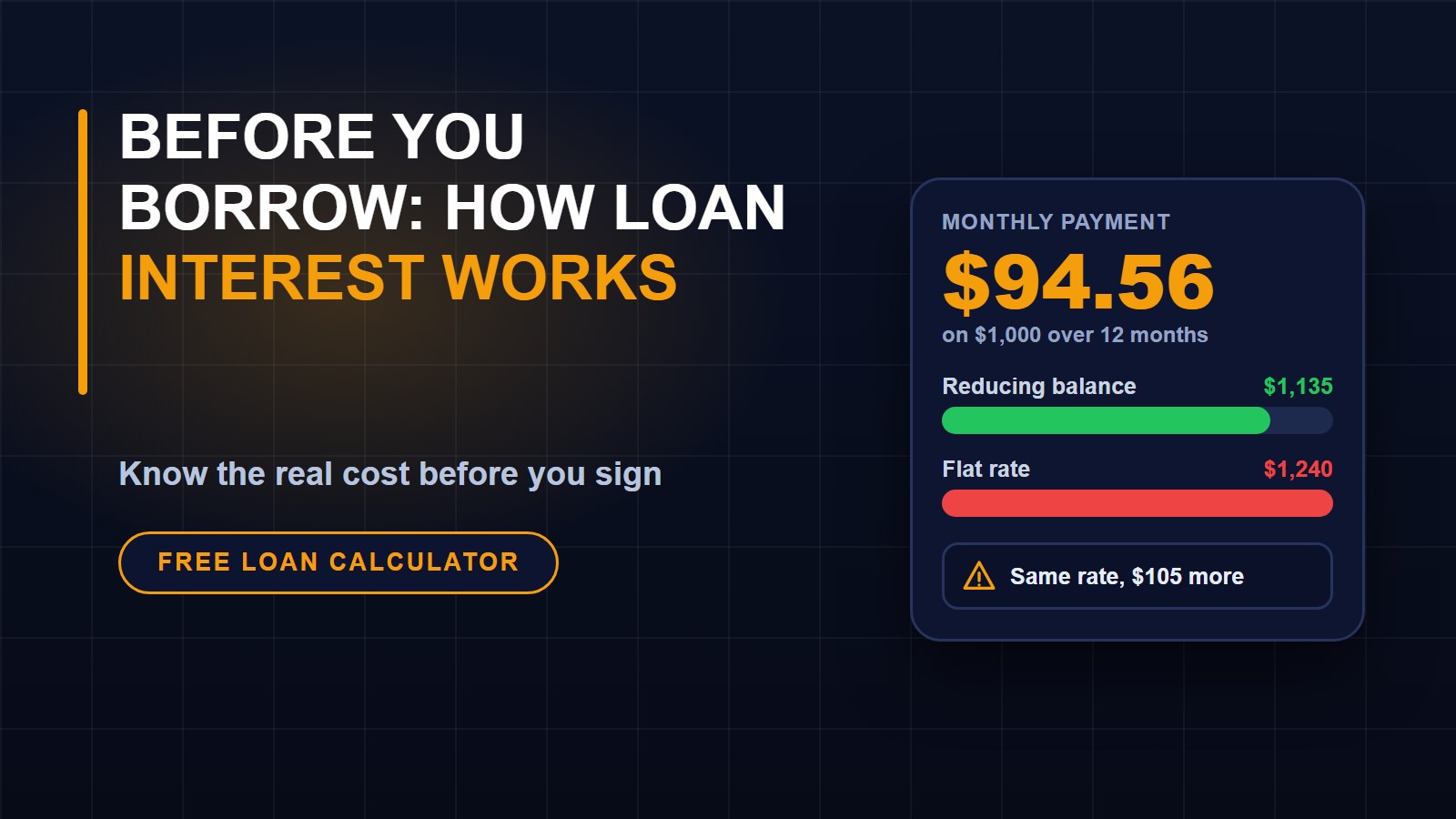
Here is an example. You borrow $1,000 for 12 months at 24% a year.
On a reducing balance, the payment is about $94.56 a month. You repay $1,134.72 in total, so the interest is about $134.72.
On a flat rate, the interest is 24% of $1,000, which is $240, charged in full. You repay $1,240 in total, about $103.33 a month.
The rate on the paper was the same, yet the second loan costs about $105 more. This is why you should always ask which method the lender uses.
Watch out for monthly rates
Some lenders quote a rate per month. A rate of 2% a month sounds small, but it is 24% a year. Multiply a monthly rate by 12 to compare it with a yearly one.
Fees count too
Application fees, insurance, service charges and penalties are often not part of the monthly figure. Add them to the total yourself, or ask the lender for the full amount you will repay in writing.
How to check a loan in four steps
1. Open the Loan calculator.
2. Type the amount you want to borrow and your currency symbol.
3. Enter the yearly interest rate and the length of the loan in months or years.
4. Read the monthly payment, the total interest and the total you will repay. The table below shows how each payment is split between principal and interest.
Try changing the length. A $5,000 loan at 18% a year over 24 months is about $249.62 a month and costs about $990.89 in interest. Stretching it out to make the payment smaller will always raise the total interest.
Questions to ask before you sign
Can I repay early, and is there a penalty? What happens if I am a few days late? Is the rate fixed or can it change? What are all the fees? What happens to anything I put up as security if I cannot pay? Get the answers in writing, and read the whole agreement, not only the first page.
Can your business afford it?
The payment must come out of what you earn, not out of hope. Use the Profit and price calculator to check your real margin and what you take home. Then compare it with the monthly payment. If the loan eats most of your profit, borrow less or wait. The percentage calculator is handy for working out what share of your income a payment would take.
Good rules to remember
Borrow only what you need. Prefer the shortest loan you can comfortably afford. Compare at least two lenders. Never borrow to repay another loan unless you have a clear plan. And be careful of anyone who asks for a fee before they release a loan; that is a common scam.
The calculator is a guide, not an offer. Your lender's figures are the ones that count, but now you will know whether they make sense. You can see more free tools on the tools page.
About the author
Francis Landford
Software Engineer | Creative Problem Solver | Innovative Software Solutions & Modern Applications
More about Francis Landford →

Discussion (0)
Sign in or create a free account to join the conversation.
No comments yet. Start the conversation.