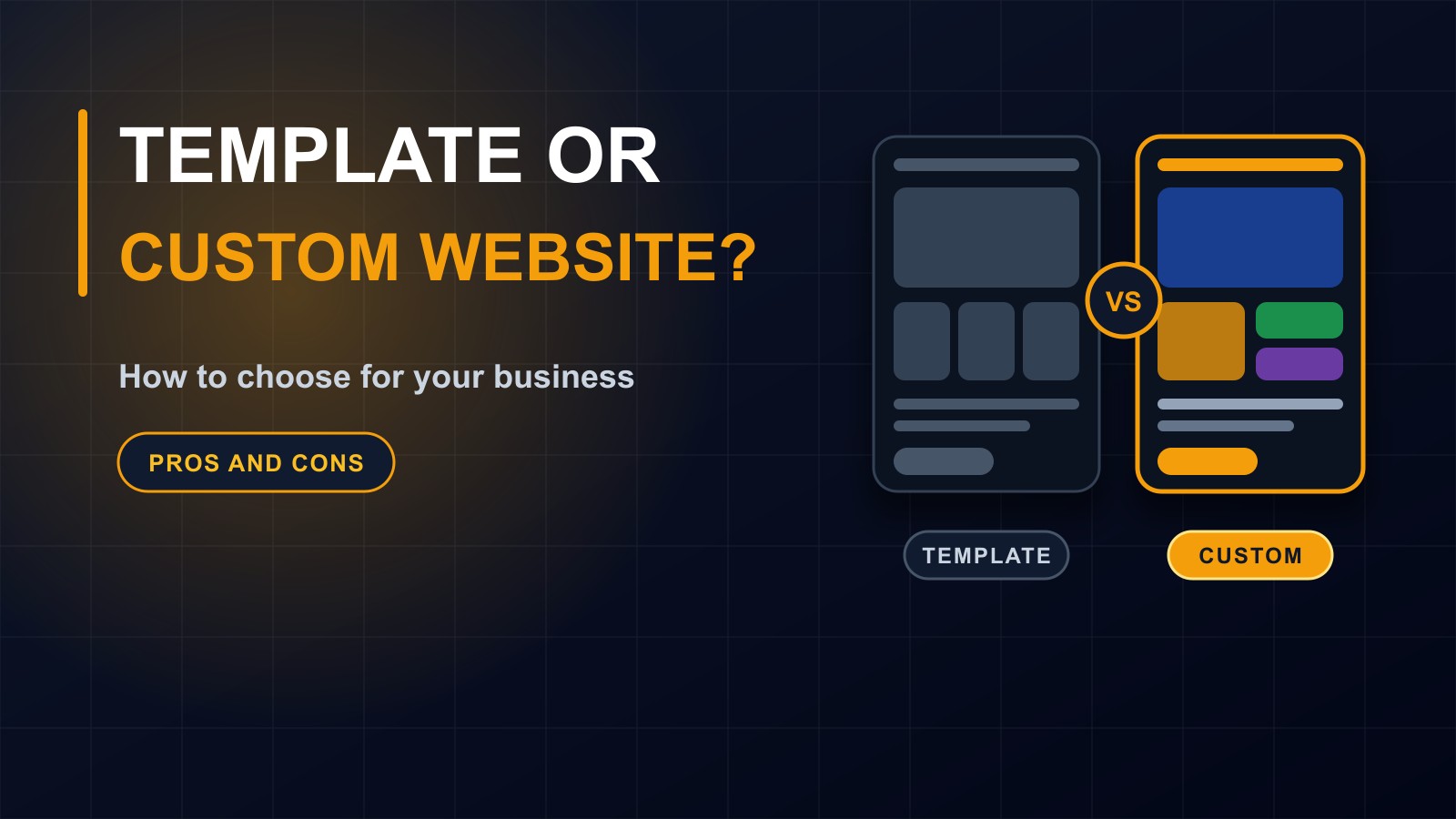
Template or Custom Website? How to Choose for Your Business
Both approaches can be right. A template can launch quickly on a small budget, while a custom build fits your exact needs and grows with you. Here are the real pros and cons, and a simple way to decide.

· 5 min read
Sooner or later every business that wants a website faces the same decision: use a ready-made template, or have something built specially for you?
The honest answer is that neither is always better. Each is right in some situations and wrong in others. The trouble is that people selling either option tend to describe only the good parts.
This post compares them fairly, so you can decide based on your business and not on a sales pitch.
What a template website is
A template is a pre-designed layout. You pick one, replace the text, images and colours with your own, and publish. Website builders and content management systems offer thousands of them, and some developers customize templates for clients.
What a custom website is
A custom website is designed and coded around your business. A designer and developer decide the layout, features and structure based on what you need, rather than starting from someone else's design.
Cost and speed
Templates are usually cheaper at the start and faster to launch. If you need a simple online presence quickly, and your budget is small, a template can be a sensible first step.
Custom work costs more up front and takes longer, because someone is designing and building everything. The question is what you get for the difference.
Uniqueness and brand
A template is used by many other businesses, so yours may look like theirs. For some businesses, that does not matter. For others, especially those competing on trust and quality, looking distinctive helps.
Custom design lets your brand, your customers and your message shape the look, the structure and the wording.
Performance and speed
Templates are built to suit everyone, so they often include features and code that you will never use. This extra weight can slow pages down, especially on phones.
A custom build contains only what your site needs, which usually means lighter, faster pages. That helps visitors and helps search visibility.
Features and flexibility
Templates are great until you need something they do not offer: a special booking flow, a connection to your accounting system, a members area with different permissions or a custom calculator. Then you either work around the limits, add heavy extras or start again.
With custom development, if you can describe it, it can usually be built.
Security and maintenance
Template systems with many add-ons need regular updates. Out-of-date add-ons are one of the most common ways websites get hacked. That is manageable, but it needs attention.
Custom sites have maintenance too, though with fewer third-party pieces there is generally less to keep updated. Whichever you choose, security, backups and updates should be part of the plan.
Ownership and freedom
Be careful here. Some website builders host your site on their own platform, and moving away later can be difficult, or you may lose the design entirely. Other templates, used on your own hosting, can be moved.
With a custom build, make sure the agreement says you receive the files, the domain and the logins. Never be locked in by accident.
Growth
A template can be a good starting point and can be replaced later when your business is bigger. A custom website can often be extended step by step as your needs grow, without starting from scratch.
A simple way to decide
Choose a template if you need to launch quickly on a small budget, your needs are simple, your brand is still taking shape and you are happy with a standard look.
Choose custom if your business depends on your website, you need special features, you want to stand out, speed and search visibility matter or you expect to grow and change.
Many businesses do both in order: a quick, simple site at the start, and a custom build once the business proves itself.
Mistakes to avoid
Buying a template and expecting it to attract customers by itself. A site is only as good as its message, content and promotion.
Choosing custom without a clear plan, which leads to a long, expensive project that never ends.
Ignoring ownership. Always ask who owns the domain, the hosting and the files.
Paying for features you will not use.
Forgetting ongoing costs for hosting, updates, security and support.
Questions to ask yourself
What is the main job of my website? What must it do that a standard design cannot? What budget and timeline are realistic? How important is it that I look different? Who will maintain it? And what will happen if I outgrow it?
Let us work it out together
If you are not sure which route suits you, I will happily look at your situation and give you honest advice, even if the answer is that a simple template is enough. I build custom websites, systems and apps, and I will never push something you do not need.
Contact me through the contact page, or call or WhatsApp me on +231 777 810 466. And if a friend is deciding between a template and custom, send them this post.
About the author
Francis Landford
Software Engineer | Creative Problem Solver | Innovative Software Solutions & Modern Applications
More about Francis Landford →