How to Accept Payments Online Safely: A Guide for Small Businesses
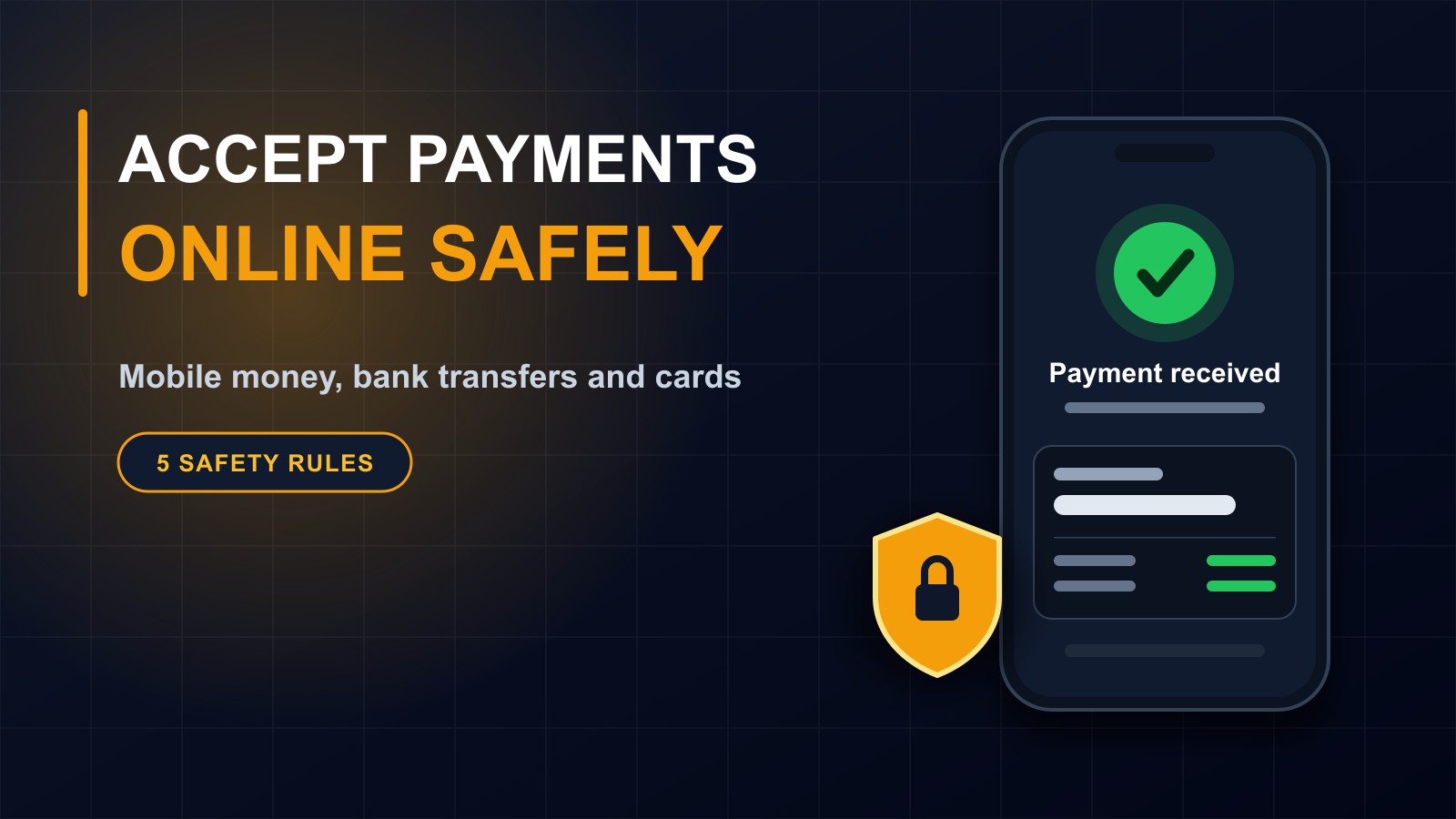
Mobile money, bank transfers and cards each have their own risks. Here are five safety rules that protect your business from fake payment screenshots, chargebacks and stolen details, and what to look for in a checkout.

· 5 min read
Getting paid is the point of every business. Yet it is also where many small businesses lose money to people who are very good at looking honest.
A customer shows a screenshot and says the money has been sent. A buyer overpays and asks for the difference back. A message from your payment provider asks you to confirm your PIN. Each of these has cost real businesses real money.
This post is a practical guide for small businesses that take payments by mobile money, bank transfer or card, in a shop, over WhatsApp or on a website. It covers five rules that prevent most of the problems.
The main ways people take payments
Mobile money services, such as MTN MoMo and Orange Money, are the most common way to pay in many places. They are fast and convenient, and everyone understands them.
Bank transfers suit larger payments and business customers, but can take time to appear.
Cards and online payment services are widely used for websites and international customers, and the card networks have strong protections, though they bring costs and sometimes disputes.
Cash is still common, and has its own risks, including fake notes and theft.
You do not have to offer everything. Choose the methods your customers actually use and that you can manage safely.
Rule 1: Confirm that the money has actually arrived
This is the most important rule. A screenshot, a message saying paid and a photo of a receipt are not proof of payment. They are very easy to fake.
Real proof is the money showing in your own account or on your own phone, from your provider, with a transaction reference that you can check. Do not hand over goods, files or access until you have seen it yourself.
If the payment appears pending, wait. Genuine customers understand. Scammers hate waiting.
Rule 2: Watch for overpayment and refund tricks
A classic scam works like this. A buyer sends, or pretends to send, more than the price, and then asks you to return the difference. When the original payment turns out to be fake or reversed, the money you sent back is gone for good.
Never refund until you have confirmed the original payment is real and final. Be especially careful with unusual stories: an urgent courier, a relative abroad, a mistake in the amount.
Rule 3: Never share your PIN, codes or login details
No genuine bank, mobile money provider or customer needs your PIN or the confirmation code sent to your phone. If anyone asks for them, even politely, even claiming to be official, it is a scam.
Be careful with messages that say your account will be suspended unless you log in through a link. Go to the official app or type the address yourself.
Use a different strong password for each payment account, turn on two-step login where it is offered and keep your phone locked.
Rule 4: Use a proper checkout on your website
If you sell online, do not ask customers to send money to a personal number and then message you a screenshot. That invites mistakes and fraud, and it looks unprofessional.
Instead, use a proper checkout that works with a recognised payment provider. A good checkout shows the amount and the business name clearly, uses a secure connection, confirms the payment automatically and records it against the order.
The website itself should not store sensitive payment details such as card numbers or PINs. The payment provider handles those. Your site should only record that the payment succeeded, plus the reference.
Check, too, that your website has a padlock in the address bar, clear prices, a refund and delivery policy and a way to contact you. Customers pay more readily when they trust the page.
Rule 5: Keep clear records
Record every payment: date, amount, customer, what was bought and the transaction reference. A simple spreadsheet is a start, though a small system that links payments to orders is better.
Records help you spot problems, answer disputes, reconcile your accounts at the end of the month and prove what happened if there is an argument. Issue a receipt or confirmation for every sale, and keep your own copy.
A few extra habits
Check the name on incoming payments, where your provider shows it. Be careful with strangers who want to pay a large amount for something quickly, especially if they will not meet or talk. Keep business money separate from personal money. Set limits and approvals if several staff handle money. And back up your records.
If something goes wrong
Contact your payment provider immediately with the details and references. Keep screenshots and messages as evidence. Stop further dealings with the person involved, change your passwords if anything was shared and, where fraud is involved, report it to the police. The sooner you act, the better your chances.
Making it easier for honest customers
Safety should not make buying difficult. Offer clear instructions, confirm payments quickly and reply politely. Most customers are honest, and a smooth, professional process makes them more likely to come back.
Want payments built into your website?
I build websites and systems with proper online checkout, including mobile money, so payments are confirmed automatically and recorded against each order. Contact me through the contact page, or call or WhatsApp me on +231 777 810 466. And if you know a business owner who still confirms payments from screenshots, share this post with them.
About the author
Francis Landford
Software Engineer | Creative Problem Solver | Innovative Software Solutions & Modern Applications
More about Francis Landford →