What Is an API? A Plain-English Guide for Business Owners
You have probably heard your developer say we will connect it through an API. Here is what that means in everyday language, why APIs matter for your business, what they can connect and what to watch out for.

· 6 min read
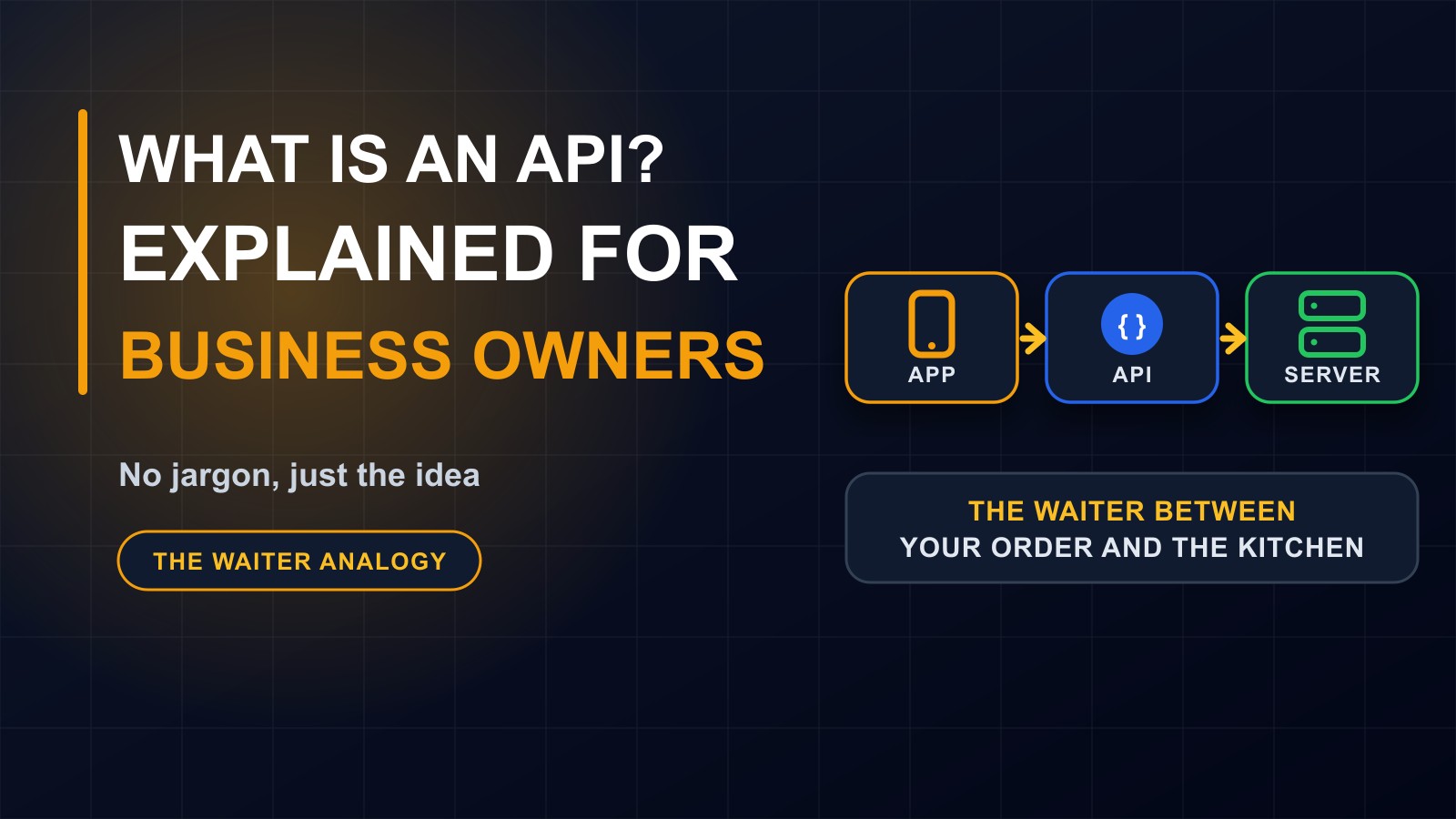
Sooner or later, a developer will say something like: we can connect that to your system through an API. If you nod politely and hope the conversation moves on, you are not alone.
The idea is much simpler than the name suggests. This post explains what an API is in everyday language, what businesses use it for, what to watch out for and which questions to ask.
The restaurant analogy
Imagine you are in a restaurant. You sit at a table with a menu. In the kitchen, the chefs have everything needed to prepare your meal. But you do not walk into the kitchen and cook. You tell the waiter what you want, the waiter carries your order to the kitchen, and later brings back your food.
The waiter is the API.
The letters stand for Application Programming Interface, but all you need to remember is this: an API is a messenger and a set of rules that lets one piece of software ask another piece of software to do something, and bring back the answer.
Why this matters
Software rarely works alone. Your website may need to take payments. Your mobile app needs to fetch information from your database. Your online shop needs shipping prices. Your system may need to send text messages or WhatsApp notifications.
Each of those needs two separate systems to talk to each other safely and in an agreed way. The API defines how: what you can ask for, what format to use and what comes back.
Everyday examples
Payments. When you pay online, the shop's website sends the amount and order details to a payment provider's API and receives a reply saying whether the payment succeeded. The shop never sees your PIN. The provider handles it.
Maps. A website that shows a map or calculates a distance asks a mapping service through its API.
Mobile apps. Most apps do not hold your data themselves. They ask a server through an API: show me this customer's orders, save this new record.
Messaging. Systems that send SMS, emails or WhatsApp notifications use messaging APIs.
Logins. Signing in with another account uses an API to confirm who you are.
Accounting and stock. Connecting your shop to your accounting software, so sales appear automatically, is usually done through APIs.
How it works in a little more detail
A system sends a request to a specific web address, saying what it wants: for example, give me the list of products. The other system checks that the request is allowed, does the work and sends back a response, usually in a simple, structured text format, often written with curly brackets that developers call JSON.
You do not need to read it. What matters is that the exchange is predictable: the same question gets the same kind of answer.
What APIs do for your business
They save time. Information entered once can flow to other systems without retyping.
They reduce mistakes. Less copying and pasting means fewer errors.
They let you use specialised services. You do not need to build your own payment system or map service. You connect to one that exists.
They make mobile apps possible. A website and a mobile app can share the same data through one API.
They help you grow. New tools can be added later without rebuilding everything.
Public and private APIs
Some APIs are offered by other companies, such as payment providers, which you connect to. Others are built by your own developer for your own system, so that your app, website and dashboard can all use the same data. The second kind is often called a back end, and it is the foundation of most modern apps.
Security matters
Because an API opens a door between systems, it must be protected.
Good APIs use secure connections, so information cannot be read in transit. They check who is asking, using logins, keys or tokens, and decide what each person is allowed to do. They limit how many requests can be made, to prevent abuse. And they validate every input instead of trusting it.
Secret keys that give access to an API should never be shared, put in public code or sent by chat. If a key is exposed, it should be replaced immediately.
Costs and limits
Many third-party APIs are free to start and charge by usage as you grow, for example per payment or per message. Others have monthly plans. Read the pricing and limits before you depend on one.
You are also relying on someone else's service. If they change their rules, raise prices or have an outage, it affects you. A good developer plans for this, with fallbacks, monitoring and clear documentation.
Questions to ask your developer
Which APIs will you use, and why? What will they cost as we grow? How will you protect the keys and our data? What happens if the other service goes down? Who owns the accounts with the API providers: you or the developer? Will there be documentation, so another developer could maintain it later?
That ownership question matters. The accounts and keys for payment, messaging and maps services should be in your name, just like your domain and hosting.
Common mistakes
Choosing a service only because it is cheap. Ignoring usage limits and pricing. Storing secret keys carelessly. Having no plan for failures. Letting the developer hold all the accounts. And building a system that cannot be connected to anything else.
Why it matters when you plan a project
If you want a mobile app, an online shop with payments or a system that talks to others, APIs will be part of the plan. Understanding them helps you ask better questions, compare quotes and avoid surprises.
Let me explain it for your project
I build systems and apps that connect through secure APIs, including mobile apps and payment integrations, and I will explain every choice in plain language. Contact me through the contact page, or call or WhatsApp me on +231 777 810 466. And if a developer has ever baffled you with jargon, share this post with a friend who has the same experience.
About the author
Francis Landford
Software Engineer | Creative Problem Solver | Innovative Software Solutions & Modern Applications
More about Francis Landford →