Does Your Website Need a Privacy Policy? What to Include and Why
If your website collects any information, from a contact form to visitor statistics, you almost certainly need a privacy policy. Here is why, what to put in it in plain language and how to keep it honest and up to date.

· 5 min read
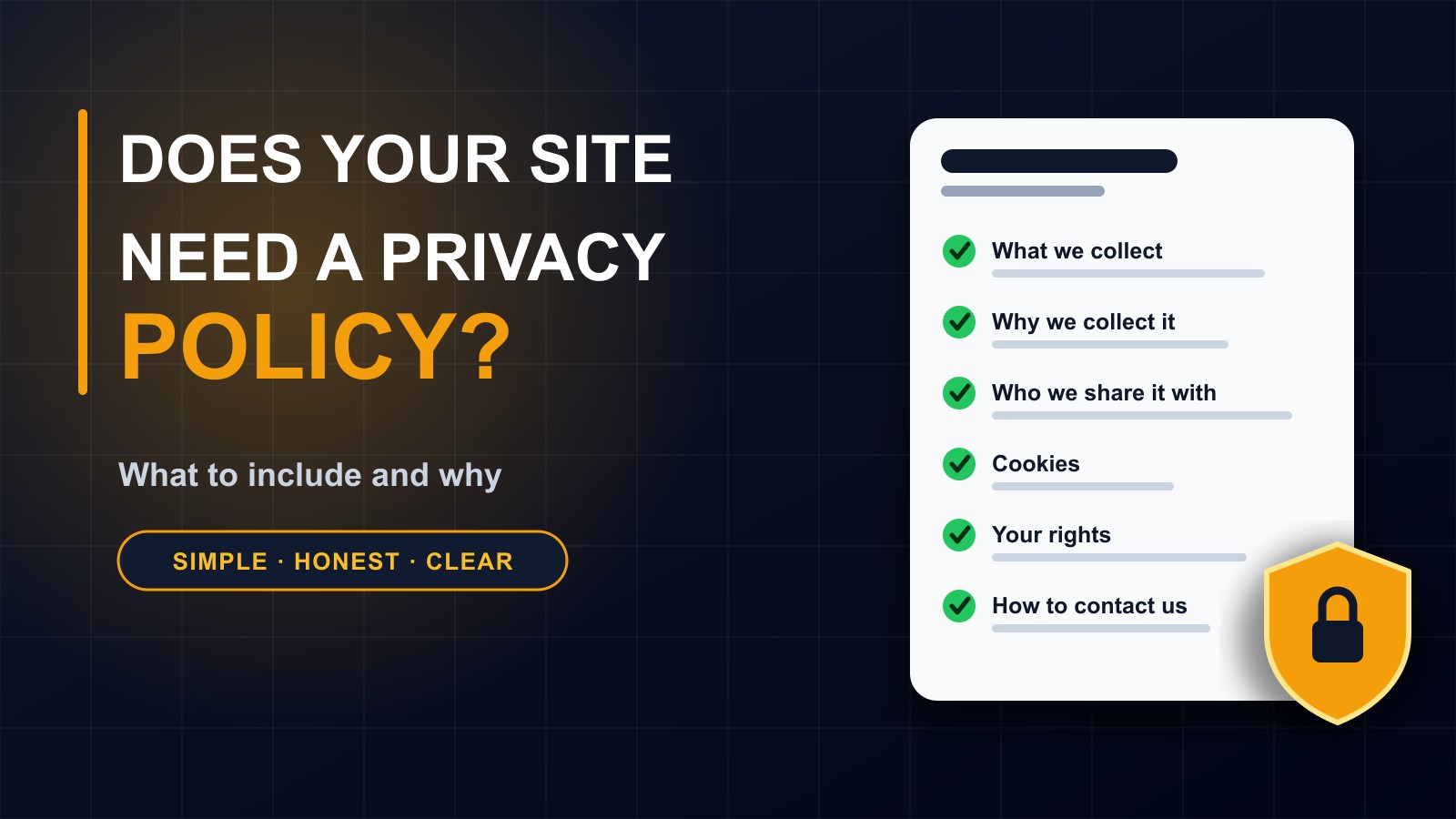
Look at the bottom of almost any professional website and you will find a link called Privacy Policy. Many small business owners ignore it, assuming it is only for big companies or lawyers.
In fact, if your website collects any information about visitors, even something as simple as a contact form or a visitor counter, a privacy policy is a good idea, and in many cases it is expected or required.
This post explains why, what to put in one in plain language and how to keep it honest.
Why you need one
It builds trust. Visitors want to know what happens to their details. A clear policy tells them you take it seriously.
It may be required. Many countries have data protection laws that require businesses to explain how they handle personal information. Advertising and analytics services, such as Google AdSense and Google Analytics, also require sites that use them to have a privacy policy.
It forces you to know your own site. Writing it makes you list what information you really collect and where it goes. Many owners discover things they had forgotten.
It protects you. If someone complains, you can point to what you said and show that you kept to it.
I am not a lawyer, and requirements differ between countries, so for anything formal or high-risk, such as handling health records, children's data or payments, take legal advice. What follows is a practical starting point for an ordinary business website.
Step 1: Find out what you really collect
Make a list. Common sources include:
Contact and enquiry forms: names, email addresses, phone numbers, messages.
Accounts and logins: names, emails, passwords (stored securely), activity.
Orders and payments: delivery details, purchase history, payment references. Remember that card and PIN details should be handled by the payment provider, not stored on your site.
Newsletters: email addresses.
Visitor statistics: pages viewed, devices, approximate location.
Cookies and similar technologies: used for logins, preferences, analytics and advertising.
Chat or AI assistants: the questions people type.
Third-party tools: maps, videos, social media buttons, advertising and analytics services, each of which may collect information.
Server logs: your hosting provider usually records technical details of visits.
Step 2: Explain it in plain language
Write for your customers, not for lawyers. Use short sentences and clear headings. A good privacy policy answers a handful of questions.
What do you collect?
Why do you collect it, and what do you do with it? Be specific: to reply to your message, to process your order, to understand which pages are read.
Who do you share it with? For example: your hosting provider, your email service, your payment provider. Do you sell it? If you do not, say so.
Do you use cookies, analytics or advertising? Name the services and explain what they do and how to opt out.
How long do you keep it? You do not need exact numbers for everything, but say how you decide.
How do you protect it? Mention secure connections, access controls and backups, without exaggerating.
What rights do visitors have? To ask what you hold, correct it, delete it or stop receiving messages.
Who can they contact? Give an email address or a contact page that you actually check.
When was the policy last updated?
Step 3: Be honest and specific
Never copy another company's policy without checking it against your own site. A policy that promises things you do not do, such as saying you never use cookies when your analytics does, is worse than none. If your practices change, change the policy.
Avoid vague phrases like we take your privacy very seriously followed by nothing concrete. Concrete statements build trust.
Step 4: Make it easy to find
Link it in your footer on every page, next to your contact details. Mention it near forms, for example, by sending this form you agree that we may use your details to reply to you, as described in our privacy policy. If you use advertising or analytics cookies, show any consent message the law or the provider requires.
Step 5: Keep it up to date
Review the policy whenever you add a new tool, change how you handle data or launch a new feature such as online payments or accounts. Update the date at the top. A quick review every six to twelve months is a good habit.
Related good practices
Collect only what you need. Do not ask for a phone number if you only need an email. Keep forms short.
Secure your site. Use HTTPS, strong passwords, two-step login for administrators and regular updates and backups.
Respect people's choices. Honour requests to delete information or stop messages.
Be careful with children's information. Schools and services for young people need extra care and often parental consent.
Train anyone who handles customer data.
Common mistakes
Having no policy at all. Copying one from another site without checking. Claiming no cookies when there are some. Forgetting third-party services. Hiding the policy where nobody can find it. Never updating it. And collecting far more than you need.
A short example of tone
Compare: Information may be processed for legitimate business purposes in accordance with applicable law. With: If you send us a message through the contact form, we store your name, email address and message so that we can reply to you. We do not sell your information.
The second tells the reader exactly what they need to know.
Need help?
I include a clear privacy policy in the sites I build, and I can review the one you have against what your website actually does, or set up analytics and consent properly. Contact me through the contact page, or call or WhatsApp me on +231 777 810 466. And if you know a business owner whose website has no privacy policy, share this post with them.
About the author
Francis Landford
Software Engineer | Creative Problem Solver | Innovative Software Solutions & Modern Applications
More about Francis Landford →