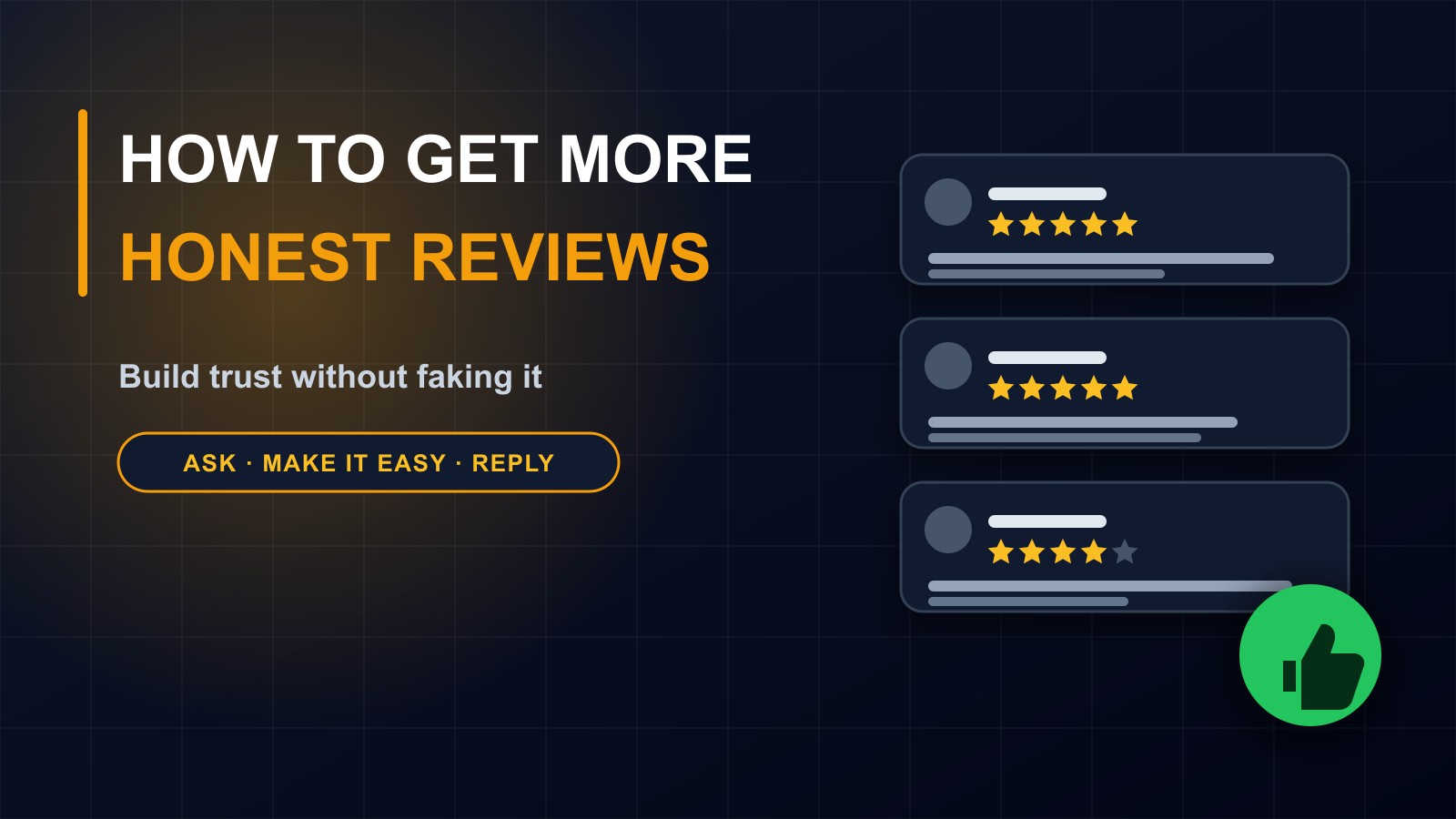
How to Get More Honest Customer Reviews (Without Faking Them)
Reviews are one of the strongest reasons people choose a business, and one of the easiest things to neglect. Here is how to ask at the right moment, make it easy, reply well and handle bad reviews, all without buying or inventing a single one.

· 5 min read
Think about the last time you chose a restaurant, a clinic, a hotel or a repair shop you had never used before. Chances are you looked at what other people said about it.
Your customers do the same. Before they call you, visit you or pay you, many of them check reviews. A few honest, recent comments from real customers can be more persuasive than any advert you could write.
The problem is that most happy customers never leave a review unless someone asks. This post explains how to collect more honest reviews, how to reply to them, and why you should never be tempted to fake them.
Why reviews matter
They build trust. Strangers believe other customers more than they believe a business describing itself.
They help people find you. Reviews and ratings can influence how prominently you appear in local search and on maps.
They teach you. Honest feedback shows what you do well and what to fix.
They help staff. Praise for a team member is a powerful motivator.
Where to collect them
Choose a small number of places that matter to your customers.
Your Google Business Profile, because it appears when people search for you and your services.
Your Facebook page, if your customers use it.
Your own website, with testimonials you have permission to publish.
Industry-specific directories or platforms, where they exist.
Focus first on one or two. A hundred reviews on one platform are better than five on each of ten.
Step 1: Do the work worth reviewing
Reviews follow experience. The best way to earn good ones is to serve customers well: be on time, do what you promised, communicate clearly and fix problems quickly. No technique replaces this.
Step 2: Ask at the right moment
The best time to ask is straight after a good experience, when the customer is pleased: after a successful delivery, a finished job, a smiling thank you.
Ask personally and politely. For example: We are glad you are happy with it. If you have a minute, would you share your experience online? It really helps other people find us.
Do not ask someone who is clearly unhappy. Deal with their problem first. If they are satisfied afterwards, they may then leave a fair review.
Step 3: Make it effortless
People are busy. The easier you make it, the more reviews you get.
Send a direct link to your review page by WhatsApp, email or SMS. Your Google Business Profile gives you a link for this. Print a QR code on receipts, counters, packaging or invoices, so that a customer can scan it and write straight away. Add a short line to the end of invoices and follow-up messages: Your feedback helps us improve.
A short message of thanks with the link, sent a day after the service, works well.
What you must not do
This is important. Do not buy reviews. Do not write reviews yourself or ask friends and staff who have never used your service to do so. Do not offer discounts or gifts in exchange for positive reviews, and do not ask customers to write only good things.
Most platforms forbid these practices, and they can remove reviews or penalise your business. Worse, fake reviews are easy to spot, and when customers discover them, they stop trusting everything else you say. In many places misleading reviews can also be illegal.
It is fine to ask for an honest review and to thank people. It is not fine to buy or invent them.
Replying to positive reviews
Reply to every review. For good ones, keep it short and personal: Thank you, Mary. We are delighted the cake arrived on time for the party. See you next time. A thoughtful reply shows future customers that a real person is listening.
Replying to negative reviews
A bad review feels personal, but it is an opportunity. Wait until you are calm. Then reply politely, in public, as if the next customer is reading, because they are.
Thank them for the feedback. Apologise sincerely where something went wrong, without making excuses or arguing. Offer to fix it and invite them to contact you directly. Keep it short and never reveal private details.
Prospective customers often judge you more by how you handle problems than by the problem itself. If a review is false, abusive or about a different business, you can report it to the platform, but do not engage in a fight.
Using reviews on your website and marketing
With the customer's permission, you can share short, genuine quotes on your website, social media and printed material, ideally with their first name and what they bought. Keep them unedited in meaning. Never alter the content or invent a quote.
Learn from the feedback
Read your reviews regularly and look for patterns. If three people mention slow replies, that is something to fix. If many praise one team member or one product, tell them and build on it.
A simple monthly routine
Once a month, check for new reviews and reply to each. Send review requests to customers served in the past week. Look at the average rating and the common themes. Choose one improvement to make. Thank your team.
A realistic expectation
You will not receive a review from every customer, and not all reviews will be perfect. A mix of mostly positive reviews with a few honest critical ones looks more believable than a wall of identical five-star comments.
Need help setting it up?
I can help you set up your Google Business Profile, create a review link and QR code, and show reviews on your website in an honest, professional way. Contact me through the contact page, or call or WhatsApp me on +231 777 810 466. And if you know a business owner who never asks for reviews, share this post with them.
About the author
Francis Landford
Software Engineer | Creative Problem Solver | Innovative Software Solutions & Modern Applications
More about Francis Landford →