From Idea to Mobile App: How an App Is Really Built
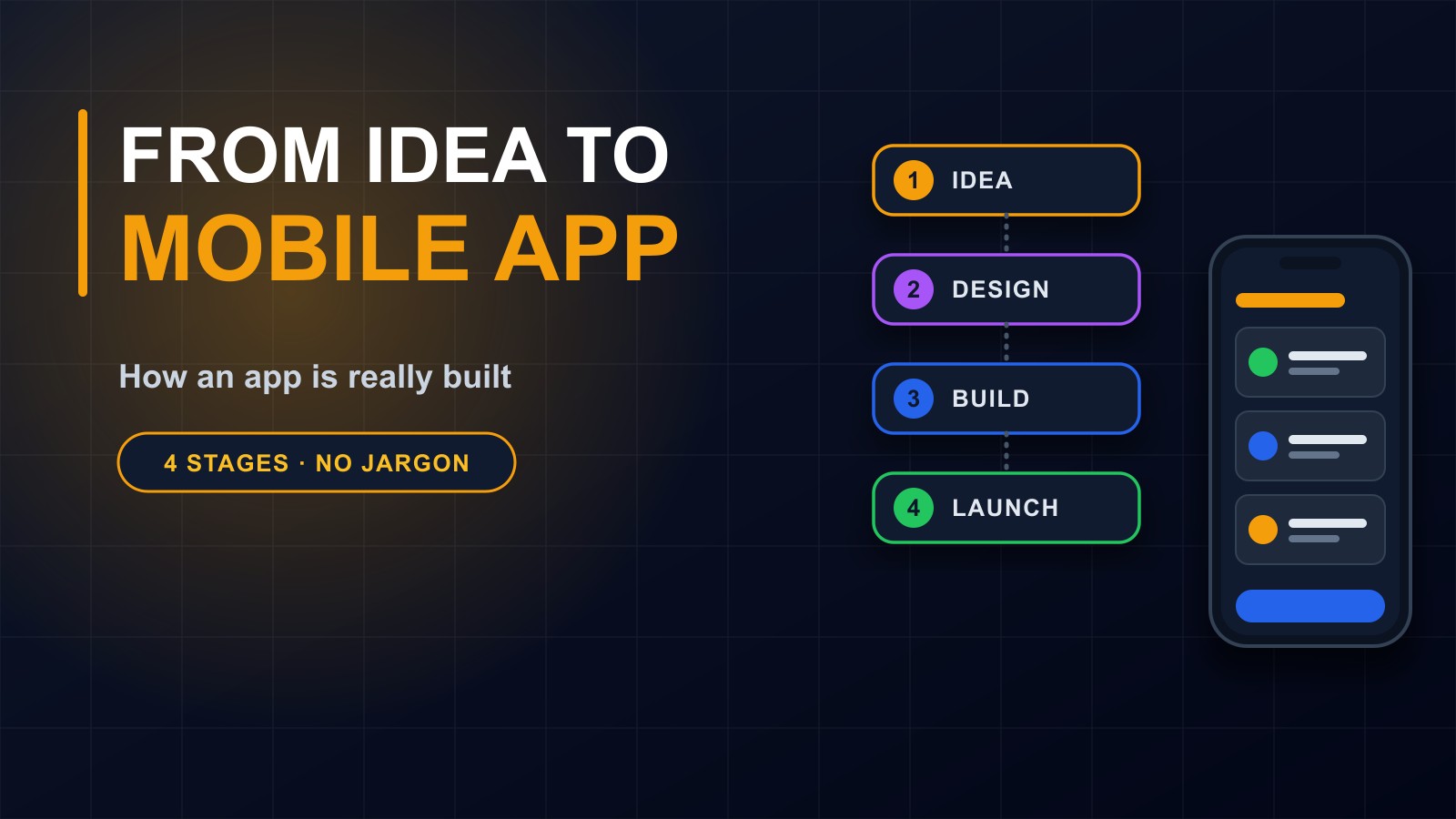
Building a mobile app is not magic and it is not just coding. Here are the four stages every app goes through, from the first idea to the app stores, what you need to decide at each step and the mistakes that waste money.

· 6 min read
Almost everyone has an app idea at some point. A way for customers to order, for students to learn, for staff to report, for patients to book. Then the practical questions arrive. How is an app actually made? What does it involve? What do I need to decide?
This post walks through how a mobile app is built, in four stages, in plain language. You do not need to be technical to follow it, and by the end you will know what to expect and what to ask.
Stage 1: Idea and scope
Every good app starts with a clear problem, not with features. Who is it for? What do they struggle with today? How will the app make that easier?
Write it down in one or two sentences. For example: farmers in this district need a quick way to check market prices without calling around.
Then decide the smallest version that is genuinely useful. Developers call it a first version or minimum product. Resist the urge to include everything. A simple app that does one job well, and that people actually use, beats a huge one that is never finished.
At this stage you also decide:
Who will use it, and on which phones. In many places most users have budget Android phones, sometimes with limited storage and unreliable connections.
Whether it needs to work offline. If your users often lose connectivity, the app should save work locally and send it when the connection returns. This choice shapes the whole design.
What data it needs, and where that data will live. Most apps talk to a server that stores information and handles logins.
What it will cost to build and to run afterwards.
Stage 2: Design
Design means deciding how the app looks and, more importantly, how it feels to use. Designers sketch each screen, the way people move between them and what happens when something goes wrong, such as no connection or a wrong password.
Good mobile design is simple. Big buttons, clear text, few steps. Think of someone using the app with one thumb, in sunlight, in a hurry.
You will usually review sketches or clickable mock-ups before any code is written. This is the cheapest time to change your mind. Changing a drawing takes minutes. Changing finished code takes days.
Stage 3: Development and testing
Now the developers build it. Most apps have two parts.
The app itself, which runs on the phone and shows the screens.
The back end, which runs on a server, stores the data, checks logins, handles payments and sends information to the app through an interface called an API.
On the app side, there are two main approaches. Native apps are written separately for Android and for iPhone. Cross-platform tools, such as Flutter, let one codebase produce both versions. Cross-platform is often a sensible choice for businesses because it can reduce time and cost while still giving a good experience, though some very specialised apps still benefit from going fully native.
Throughout development, the app is tested. This means checking every screen and feature on real phones, not only on a computer. It means testing slow connections, small screens, older versions of the operating system and unusual situations: what happens if the user turns on airplane mode in the middle of an order?
Security belongs here too: protecting logins and data, checking input and keeping secrets out of the app itself.
You should see working versions early and often, so you can give feedback while changes are still easy.
Stage 4: Launch and updates
To publish an app, it goes to the official stores: Google Play for Android and the App Store for iPhone. Each store has its own rules. You need a developer account, a description, screenshots, an icon, a privacy policy and honest answers about the data your app collects. Apps are reviewed before they appear, which can take time and sometimes requires fixes.
Make sure the developer accounts are created in your own name or your organization's name, not the developer's. Otherwise you may not control your own app.
Launch is not the finish line. Real users find things testing missed. Phones and operating systems change, so apps need regular updates. Servers need monitoring and backups. And your users will ask for improvements.
Plan for ongoing support from the start, with clear terms.
What affects cost and time
The number of screens and features. Whether you need accounts, payments, maps, notifications or offline mode. Whether there is an admin dashboard or website alongside the app. The quality of design. The number of platforms. Integration with other systems. And how quickly decisions and feedback arrive.
A simple app can be built much faster than one with many roles, workflows and integrations. As with websites, ask for a written plan with an itemized quote.
Common mistakes
Starting with features instead of a problem. Trying to build everything in version one. Ignoring users with slow phones or poor connections. Skipping testing on real devices. Forgetting the back end, which is often as much work as the app. Letting a developer own your store accounts. And launching with no plan for support and updates.
Do you really need an app?
Sometimes a mobile-friendly website, or a simple progressive web app, does the job for far less. An app makes most sense when you need features such as offline work, notifications, the camera, location or something people will use daily. I wrote a separate post about choosing between a website and an app.
Questions to ask your developer
Which approach will you use, and why? Will it work offline? Where will the data be stored, and who owns it? Who owns the store accounts and the source code? How will you test? What happens after launch, and what does support cost?
Good answers are clear and in writing.
Let us talk about your idea
I build mobile apps, including offline-first apps for places where connections are unreliable, together with the websites and back-end systems that support them. If you have an idea, I will tell you honestly whether it needs an app, what the first version should include and what it will take.
Contact me through the contact page, or call or WhatsApp me on +231 777 810 466. And if you know someone with an app idea, share this post with them first.
About the author
Francis Landford
Software Engineer | Creative Problem Solver | Innovative Software Solutions & Modern Applications
More about Francis Landford →