Still Using Paper and Excel? 7 Signs Your Business Needs a Management System
Paper files and spreadsheets work until the day they do not. Here are seven clear signs that your school, company or organization has outgrown them, and what a proper management system changes.

· 5 min read
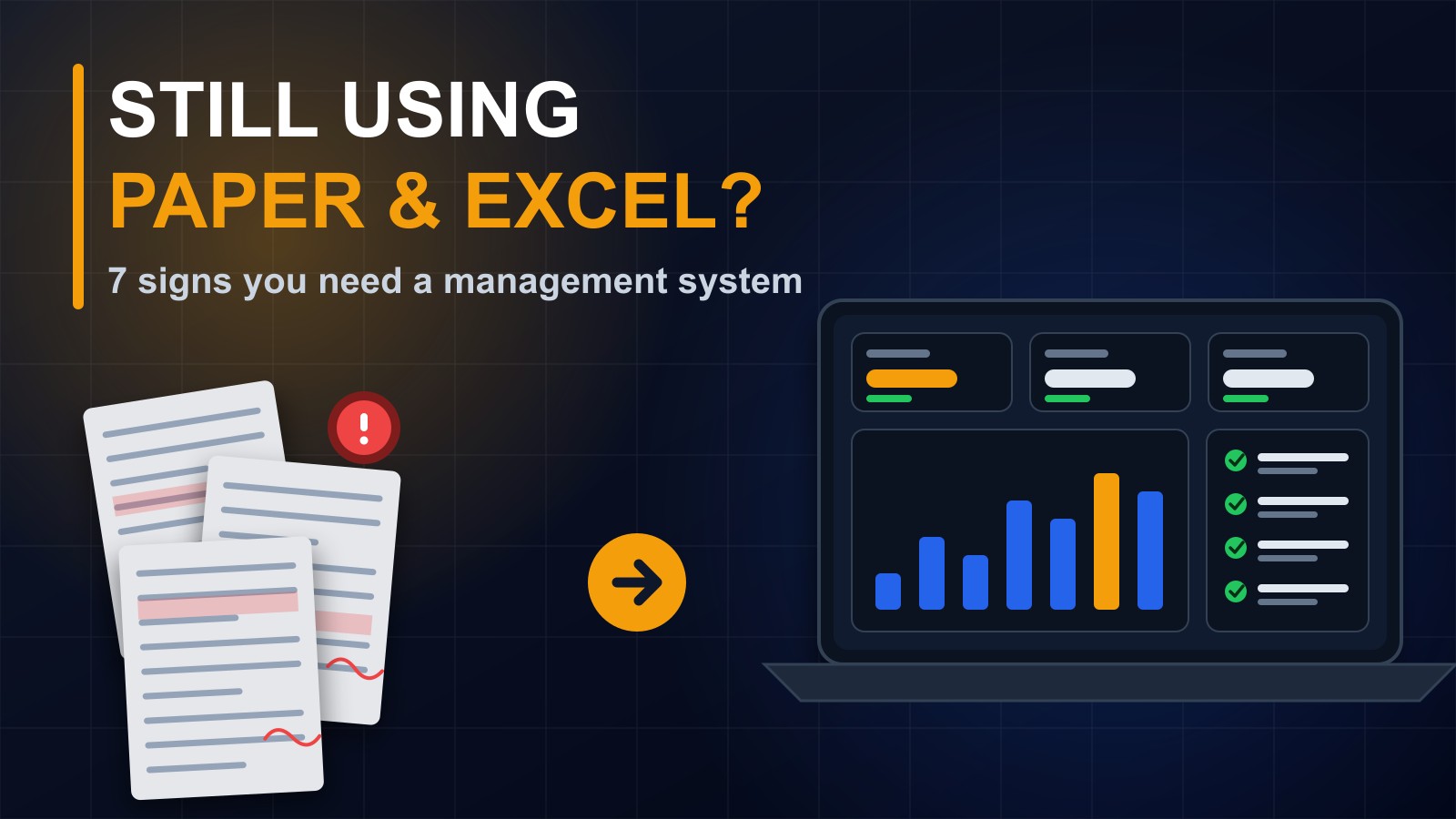
Almost every organization starts the same way. A notebook for records. A folder of papers. Then a spreadsheet, because the spreadsheet feels modern and it is free. For a while, it works.
Then the business grows. More students, more customers, more staff, more transactions. The spreadsheet gets longer and heavier. Someone makes a copy to be safe. Someone else changes the copy. Now there are three versions and nobody is sure which one is right.
If that sounds familiar, you have not done anything wrong. You have simply outgrown your tools. This post lists seven signs that it is time to move to a proper management system, and what changes when you do.
Sign 1: You cannot find things quickly
A parent asks for a payment record, a customer asks about an old order, or an inspector asks for last year's results. Someone has to dig through files, boxes or a folder full of spreadsheets, and it takes an hour, if it is found at all.
In a management system, every record is searchable. Type a name or number and it appears in seconds, with the full history attached.
Sign 2: The same information lives in many places
A student's name is in the register, the fee sheet and the exam list. When the spelling or phone number changes, someone has to fix it three times, and one of them is always forgotten.
A system stores each fact once and uses it everywhere. Change it in one place and every report is correct.
Sign 3: The totals never quite agree
Two people add up the same month and get two different numbers. A formula was overwritten. A row was deleted by accident. A cell was typed by hand instead of calculated.
Mistakes in money are the most expensive kind. A system calculates fees, balances, stock and payroll the same way every time, so the numbers can be trusted and checked.
Sign 4: Reports take days
At the end of the term or the month, someone spends days collecting information from different sheets and forms to build one report for the owner or the board. By the time it is ready, it is already out of date.
With a system, the report is already there. Open the dashboard and see attendance, income, outstanding balances or shipments as they stand today.
Sign 5: Anyone can see or change anything
A shared spreadsheet or a pile of open files has no real access control. A junior staff member can see salaries. A mistake by anyone can erase everyone's work. And when something goes wrong, nobody knows who did it.
A system gives each person a login and a role. Teachers see their classes. Accountants see payments. Managers see everything. And every change is recorded, so there is an honest history of who did what and when.
Sign 6: One person holds all the knowledge
Everything works because of one clever employee who knows where everything is. If that person is sick, busy or leaves, the organization is stuck.
A system holds that knowledge for you. New staff can be trained in days, and the organization no longer depends on one person's memory.
Sign 7: You are afraid of losing it all
A flood, a fire, a stolen laptop or a failed hard drive can wipe out years of paper files or a single spreadsheet in one afternoon. Many organizations never recover from it.
A system on a secure server is backed up regularly, so one accident does not erase your history.
What a management system actually does
Using a management system does not mean learning something complicated. It simply moves your daily work from scattered files to one organized place.
For a school, that means student records, attendance, results, fees and parent communication in one system. For a business, it can mean customers, orders, stock, invoices and staff. For operations like shipping or logistics, it can mean tracking shipments, vessels, documents and costs from start to finish.
Good systems also work on a phone, so managers can check what is happening without sitting at a desk.
Off the shelf or built for you
You can buy a ready-made product or have one built for your exact way of working. Ready-made is cheaper at the start but often forces you to change how you work to fit the software. A system built for you fits the way your organization already runs, and it can grow as you do.
Whichever you choose, ask before you buy who will support it, who owns your data, and how updates are handled. Software that nobody answers calls about is worse than no software at all.
How to start without a big risk
You do not need to change everything in one day. Begin with the area that hurts the most, for example fees, attendance or stock. Move that first, train the team, and then add the next area. Keep your old records safe until you are confident.
Let us talk about your situation
I build school management systems, business and operations systems, e-learning platforms and mobile apps for organizations, and I build each one around how that organization actually works. If you recognize two or three of these signs, tell me about your situation and I will tell you honestly what would help and what would not.
Reach me through the contact page, or call or WhatsApp me on +231 777 810 466. And if you know a school or business still running on paper and spreadsheets, share this post with them.
About the author
Francis Landford
Software Engineer | Creative Problem Solver | Innovative Software Solutions & Modern Applications
More about Francis Landford →